
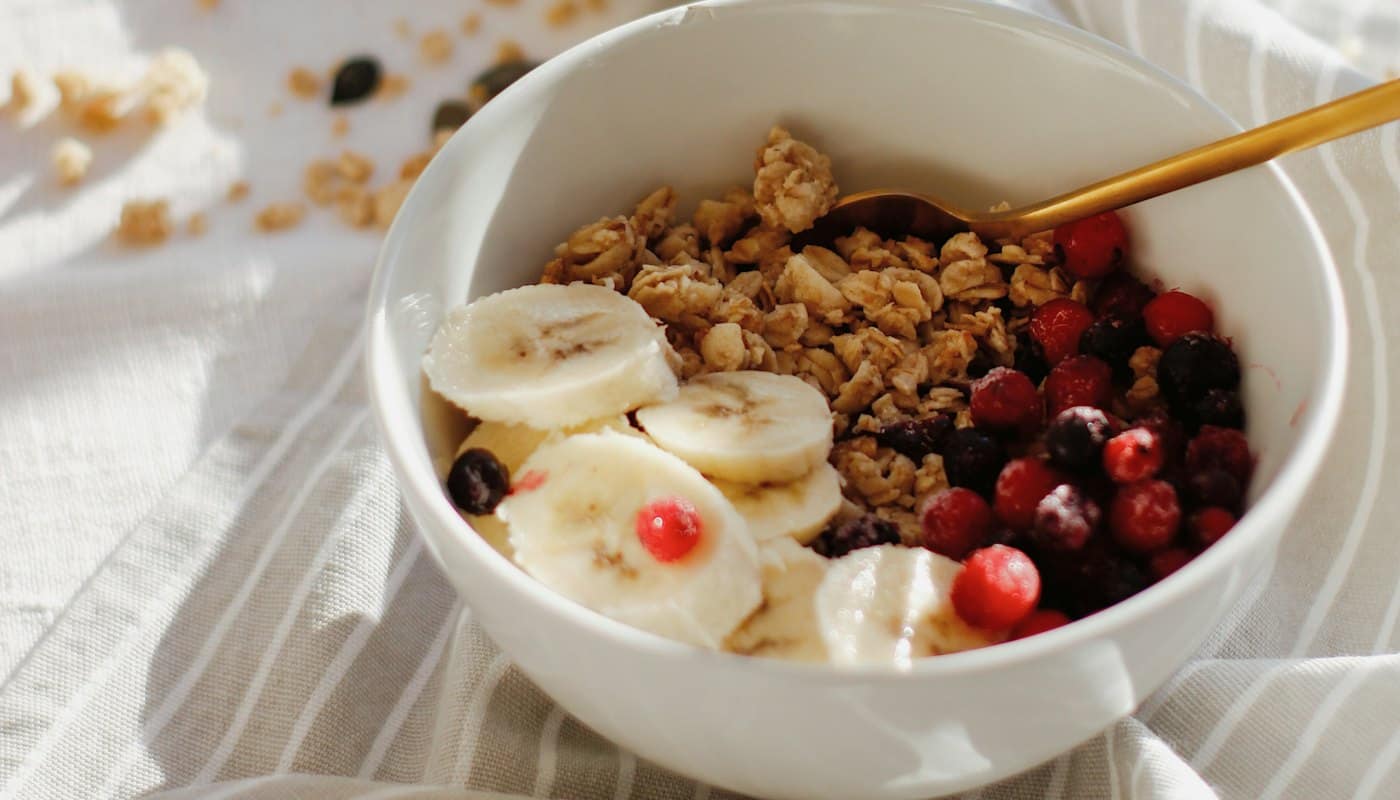
Dietary fibre is usually split into soluble and insoluble types, which behave differently in the gut but arrive together in most plant foods. This article explains what each type does, where to find it, and why a varied plate matters more than tracking the two separately.
What is the difference between soluble and insoluble fibre?
Fibre is the part of plant food that the body does not fully digest. The British Dietetic Association (BDA) groups it by how well it dissolves in water, how thick it becomes and how far gut bacteria can break it down.
- Soluble fibre dissolves in water. It includes pectins and beta-glucans, with fruit and oats given as examples.
- Insoluble fibre does not dissolve and includes cellulose. Wheat bran and nuts are the examples the BDA gives.
The British Heart Foundation (BHF) describes the practical picture in similar terms. Soluble fibre forms a gel in the gut that keeps stools soft, while insoluble fibre passes through without being broken down and helps food move along.
In real food the line is blurry. An oat, an apple or a lentil contains a mixture, and the proportions vary with the variety and how it is prepared. That is one reason the split is a helpful guide and not a precise measure.
Which foods give you which type?
The BHF lists these as typical sources:
| Type | Typical foods |
|---|---|
| Soluble | Oats, barley, rye, fruit, beans, pulses, and vegetables such as carrots and potatoes |
| Insoluble | High-fibre breakfast cereals, wholegrains, vegetables, potatoes with their skins on, nuts and seeds |
Several foods appear in both rows, which shows how much overlap there is. Beans, for instance, contain a good deal of both kinds.
Total fibre per 100g gives a sense of scale. According to the BHF, red kidney beans contain 11.1g, porridge oats 7.8g and green and brown lentils 7.4g. Both the BDA and the BHF give 5.6g for peas and 4.9g for baked beans in tomato sauce. These are per 100g of the food as listed, so a real portion may be larger or smaller.
Does soluble fibre lower cholesterol?
There is a specific, reasonably well-described link here. The BHF says that some soluble fibre, such as the oat beta-glucans found in porridge, can help lower blood cholesterol by reducing the amount of cholesterol absorbed in the gut. The BDA also cites trials in which eating oat bran led to lower total cholesterol and lower blood pressure.
It helps to keep the claim in proportion. Oats are one useful part of an eating pattern, not a treatment. The NHS advice on cholesterol focuses on cutting back on fatty food, particularly saturated fat, and eating more wholegrains, fruit and vegetables. For the wider picture, see our guide to cholesterol and what the numbers mean. Neither the BHF nor the BDA gives a gram amount of beta-glucan to aim for.
What does insoluble fibre do for the bowels?
Insoluble fibre adds bulk and helps food move through the gut, which is why wholegrain cereals and bran are traditional answers to sluggish digestion. The BDA says that eating a range of fibre can improve constipation, though it does not say which type is responsible.
The NHS advice on constipation is practical. It suggests gradually increasing fibre, for example with wheat bran, oats or linseed, and including fruits such as apples, apricots, grapes, raspberries and strawberries. It also lists drinking plenty of fluids, limiting alcohol and being active, such as a daily walk, as things that can help. Not drinking enough and being inactive are both named as common causes of constipation.
The BDA adds a reminder that fibre draws water into the bowel, so you can become dehydrated if you do not drink enough. Our guide to how much you should drink a day covers what counts.
How much of each type do you need?
There is no target for either type. The BHF states plainly that there are no specific recommendations on the amounts of each type of fibre you should eat. The overall advice is the same one that applies to everyone: adults are advised to aim for around 30g of total fibre a day, and the BDA puts the UK average at about 18g, which is roughly 60% of that. Our companion piece on how much fibre you need and how to reach 30g sets out the survey data and a full day of meals.
The sensible conclusion is that you do not need to count soluble and insoluble grams. If your diet includes oats or barley, pulses, fruit and vegetables, wholegrain bread or pasta, and nuts and seeds, you are very likely getting both.
A worked example: one day, both types
This illustrative day uses figures from the NHS example menu, which gives approximate totals.
- Breakfast: two slices of wholemeal toast with peanut butter and a medium orange, about 8.3g
- Lunch: wholemeal spaghetti with a lentil and tomato sauce, about 11g
- Dinner: grilled chicken breast, a baked potato with the skin on, carrots and green beans, about 11.2g
Illustrative arithmetic: 8.3g + 11g + 11.2g = 30.5g. The orange, lentils, potato and carrots lean towards soluble fibre, while the wholemeal bread, wholemeal pasta, potato skin and nuts in the peanut butter lean towards insoluble. Swapping the toast for a bowl of porridge would shift the balance towards oat beta-glucan without needing any special products.
Common mistakes and misconceptions
“One type is good and the other is not.” Both are part of a healthy pattern, and there is no basis for cutting either out in a healthy person.
“Fibre supplements are the same as food.” Foods bring other nutrients with them. The NHS advice centres on foods, and the NHS also advises eating a variety of sources, because relying on too much of one food may not give a balanced diet. Highly processed products with added fibre are not automatically a better choice than whole foods; our look at ultra-processed foods and the evidence explains why.
“More is always better, straight away.” Raising intake quickly commonly causes wind and bloating. The BDA advises increasing gradually to avoid bloating and gas.
“Dried fruit is a free pass.” The NHS notes that dried fruit is sticky and can increase the risk of tooth decay, so it is best eaten with a meal rather than as a between-meal snack.
Who may need a different approach?
Some people find that fermentable fibre in larger amounts makes symptoms worse. According to the BDA, in people with irritable bowel syndrome (IBS) it can cause bloating, gas and diarrhoea, and advice should be adapted to their medical history and tolerance. The BDA suggests seeing a dietitian if you have IBS, ongoing constipation or diarrhoea, or a condition that restricts fibre intake, such as inflammatory bowel disease.
If you have a diagnosed bowel condition, follow the plan agreed with your clinical team rather than a general rule. Do not stop any prescribed medicine without speaking to your GP first.
When to speak to a GP or NHS 111
The NHS advises seeing a GP if you:
- are constipated and it is not improving with treatment, or you are regularly constipated or bloated
- have blood in your poo, tummy pain or sudden changes in bowel habits
- have lost weight without trying
- are constipated and tired all the time
- take a medicine, such as an opioid painkiller, that is causing constipation
For constipation that does not respond to diet and lifestyle changes, the NHS says a pharmacist can suggest a suitable laxative, which should only be used for a short time. If you are unsure how urgent a symptom is, NHS 111 can advise.
Conclusion: eat the variety, skip the spreadsheet
Soluble and insoluble fibre are useful labels for understanding what plant foods do, but they are not something to track. Oats, barley, pulses, fruit, vegetables, wholegrains, nuts and seeds between them cover both. Build up slowly, drink enough fluid, and treat persistent bowel changes as a reason to get checked, not a reason to add more fibre.
This is general information, not a substitute for advice from a doctor or other qualified health professional. If you are worried about your digestion or any symptoms, speak to your GP or call NHS 111.
Sources: British Dietetic Association; British Heart Foundation; NHS